The Arizona Baseball Trail

Well before Arizona became a state, baseball played a significant role in the region’s social, recreational, and economic development. Even while the Indian wars raged and outlaws roamed the territory, there was baseball.

A new program called the Arizona Baseball Trail celebrates that legacy.

The Trail will be a self-guided tour of landmark sites that not only tells the story of pioneer baseball, but also the rowdy and competitive mining leagues, the barnstorming days of Major League Baseball, the rich legacy of championship high school and college programs, the beginnings of the Cactus League and the current era of sprawling baseball campuses that support a billion-dollar industry.

The trail begins with a “Starting Nine” list of historic sites that played a critical role in the development of Arizona baseball. Additional sites will be added in the future. The plan is to celebrate each location with a plaque, a web page description and a place on the Arizona Baseball Trail map.

Participants who follow the trail will discover fresh insights into America’s Pastime and a mosaic of frontier landmarks, hidden gems and living history that tell the story of both Arizona and baseball.

Contests, collectables, exhibits and other activities will also be part of the trail – a modern adventure that will honor the past, celebrate the present and peer into the future.

About Arizona Baseball Legacy & Experience
The mission of ABLE is to celebrate Arizona baseball and educate the public about its history, culture, and benefits.

It does this by preserving and displaying significant artifacts, storytelling, and celebrating the individuals and organizations that have contributed to the Cactus League and other facets of Arizona baseball past, present and future.

ABLE has partnered with several organizations to produce popular and award-winning exhibits, including the Scottsdale Historical Society, the Mesa Historical Museum, the Arizona Heritage Center–Papago Park, the city of Scottsdale, and the Los Angeles Dodgers at Dodger Stadium.
Scottsdale Stadium

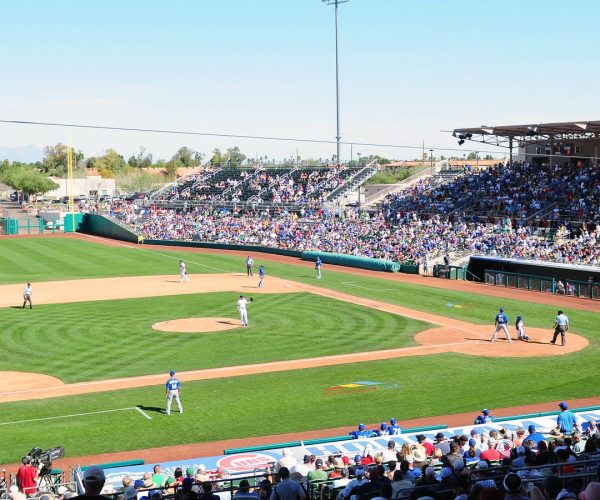
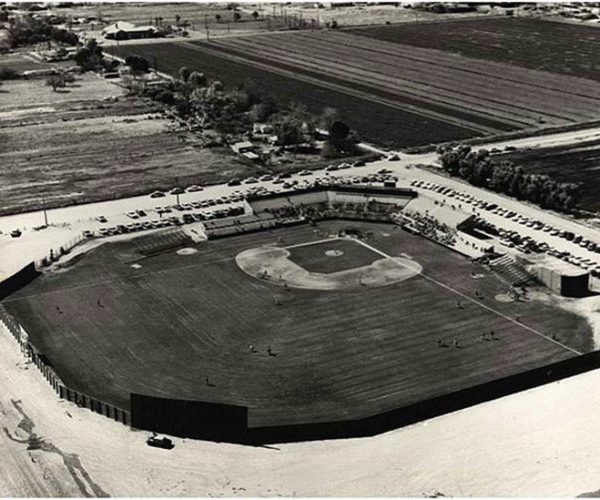
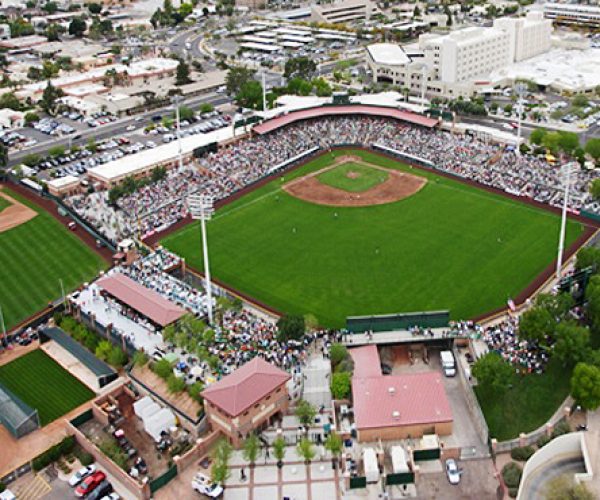
Scottsdale Stadium is the oldest continuous venue in the Cactus League. The original stadium opened in 1956 and hosted the Baltimore Orioles for two seasons. It has also been the home training site for the Boston Red Sox, Chicago Cubs, and Oakland Athletics. The San Francisco Giants became its fifth spring training tenant in 1982 and continue to train there. In 1991, the stadium was completely rebuilt and expanded on the same site. The stadium also hosts Fall League games and various special events. It is home to the Scottsdale Sports Hall of Fame and the Fall League Hall of Fame.

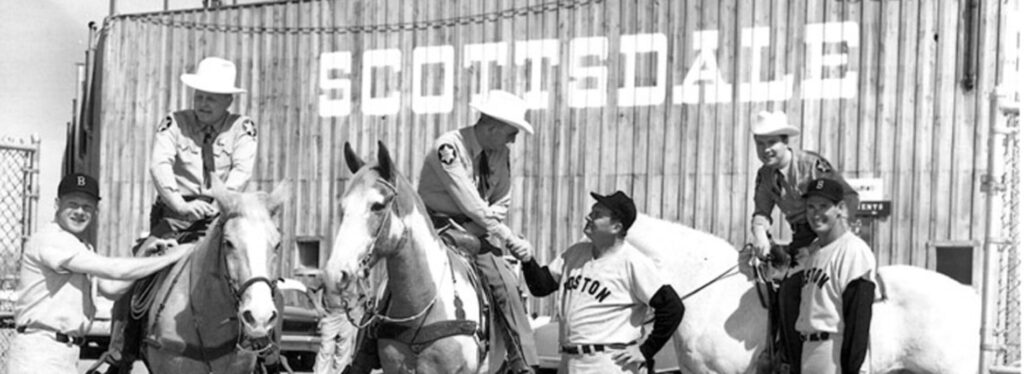
Fun fact: In 1960, three of the greatest hitters of their generation—Ty Cobb, Ted Williams, and Carl Yastrzemski—were together at Scottsdale Stadium. Ty Cobb was a special assistant for the Red Sox, Ted Williams was ending his storied career and Carl Yastrzemski was a rookie.

Phoenix Municipal Stadium

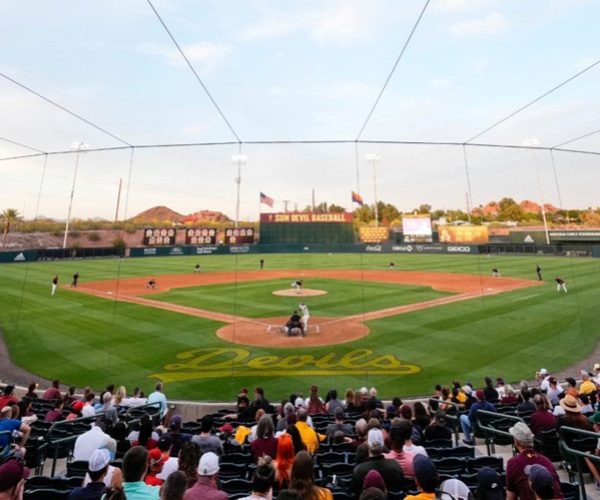
Phoenix Municipal Stadium opened in 1964 as the spring training home of the San Francisco Giants. The Giants’ AAA minor league team, also named the Giants, began play at the stadium in 1966. After the 1981 spring season, the SF Giants moved to Scottsdale and the Oakland Athletics called Phoenix Muni their spring home until 2014. The AAA Giants (renamed the Firebirds in 1986) remained at Muni through the 1991 season before also relocating to Scottsdale Stadium. The Arizona State University Sun Devil baseball team moved into the stadium in 2013 and remains there today.

Fun fact: The light poles at Phoenix Muni were originally installed in 1940 at the Polo Grounds in New York City. In 1964, the Giants ownership installed them at Muni.    

Chase Field

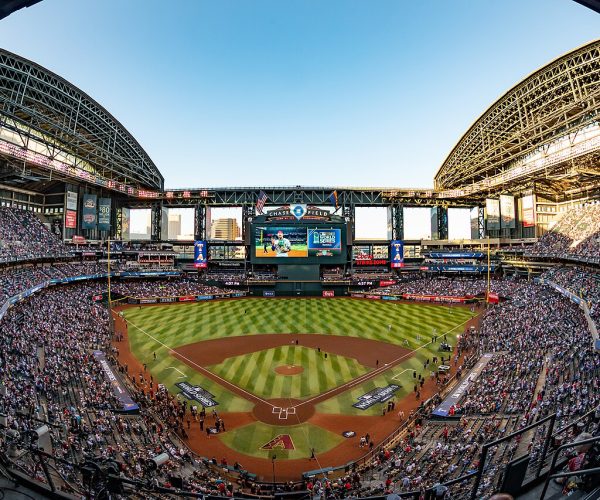
Chase Field in downtown Phoenix, previously known as Bank One Ballpark, is home to the Arizona Diamondbacks. It opened in 1998 and immediately set a couple of firsts for Major League Baseball. It was the only retractable-roof stadium in the U.S. to feature a natural grass field. It also boasted a swimming pool in centerfield that could be rented to groups on a per game basis. The swimming pool remains, but the sod proved too hard to maintain and was replaced in 2019 with artificial turf. The Diamondbacks also established a Major League first in 2001 by becoming the fastest expansion team to win the World Series.

Fun fact: Chase Field is the second highest stadium in MLB behind only Denver’s Coors Field.   

Francisco Grande

Francisco Grande was a baseball-themed attraction decades ahead of its time.

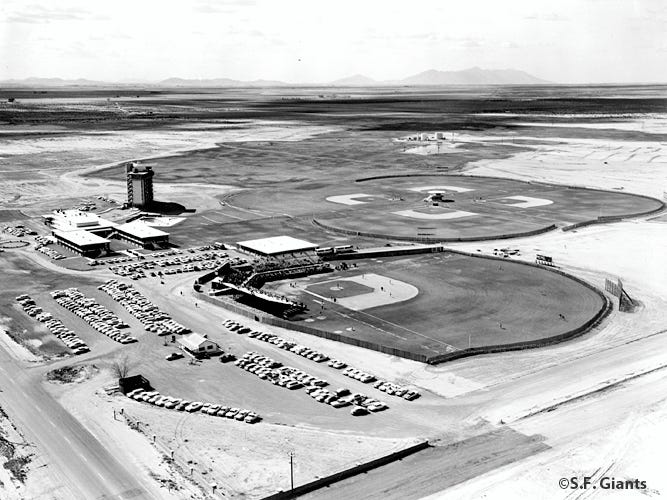
Opened in the spring of 1961, the stylish hotel/ballpark complex located roughly 60 miles south of Phoenix boasted a cloverleaf of practice fields, complete with observation tower and a main field seating 3,000. 

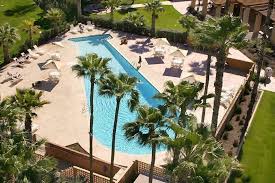
The brainchild of long-time Giants owner Horace Stoneham, the complex included an eight-story hotel topped off by what looked like a baseball cap – with concrete brim providing shade for a rooftop patio. The grounds included a baseball-bat shaped swimming pool, and a hot tub shaped like a ball.

The complex was used for training and intersquad practice games while the Giants played their exhibition games at Phoenix Municipal Stadium. 

Stoneham wanted a place where players and fans could mingle over dinner, take in a round of golf or go fishing on a stocked three-acre lake. The location proved too isolated for most fans, however, and the training complex closed in 1981.

But the baseball vibes remain. Francsico Grande continues as an active resort/golf hotel. The lobby and hallways are filled with player photos from the Giants era, and these days the grounds serve as training fields for international soccer teams.

 Fun Fact: Actor John Wayne and singer Paul Anka both owned penthouse apartments on the hotel’s top floor. Wayne was the proprietor of the neighboring Rooster Cogburn Cattle Ranch, and the Francisco Grande bar is filled with photos and memorabilia from his spread.  

Hi Corbett Field

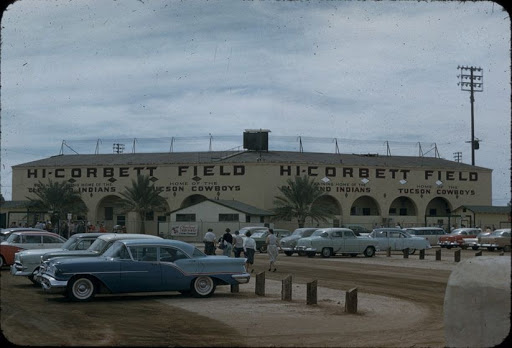
Tucson’s Hi Corbett Field opened in 1927, just 15 years after Arizona achieved statehood. Originally named Randolph Municipal Park, it was renamed in 1951 to honor former state senator and early spring training supporter Hiram “Hi” Stevens Corbett. 

Early tenants of the historic ballpark were the Tucson Waddies and Tucson Cowboys of the Arizona State League, an affiliated Class C professional league.  In 1947 the venue became one of two Arizona locations hosting Major League Baseball spring training. That first tenant was Bill Veeck’s Cleveland Indians. Horace Stoneham’s New York Giants set up camp in Phoenix, sowing the seeds for what would eventually become the Cactus League. Cleveland continued to conduct its spring camp at Hi Corbett Field until 1992 and was replaced by the expansion Colorado Rockies in 1993. The Rockies moved out of Hi Corbett in 2010. The ballpark hosted two incarnations of the Tucson Toros Pacific Coast League minor league teams from 1969-2011. The nearly 100-year-old ballpark has served as home to the University of Arizona baseball team from 2012. Fun fact: Hi Corbett Field starred as itself in 1989 hosting spring training scenes for the movie Major League.  

Peoria Sports Complex

In 1993 the Cactus League was in big trouble; teams were relocating to Florida or threatening to do so.

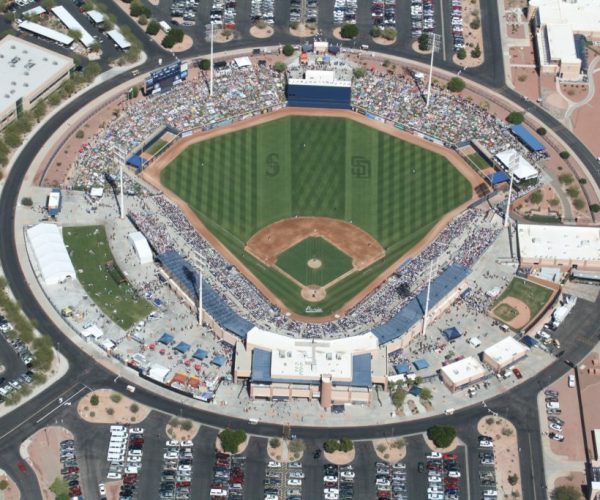
Enter the Peoria Sports Complex with an innovative concept. It became the first spring training facility to host two teams, partnering with the San Diego Padres and the Seattle Mariners. The move sparked growth and expansion of both the Cactus League and the West Valley and provided a catalyst for economic development in the city of Peoria.   

Baseball fans have seen a succession of superstars and Hall of Famers start and continue their careers at the Peoria Sports Complex including Ken Griffey Jr., Randy Johnson, Edgar Martinez and Ichiro Suzuki for the Seattle Mariners. Hall of Famer Tony Gwynn spent all 20 years of his career with the Padres, spending the final eight spring seasons of his career in Peoria. Padres Hall of Fame closer Trevor Hoffman was there for the opening of the Sports Complex and trained there for the next 14 seasons.     

In 2003, the Kansas City Royals and Texas Rangers moved their spring training operations from Florida to Surprise Stadium in Surprise and the western migration of teams to the Cactus League was on. 

Fun Fact: The Peoria Sports Complex added the “Peoria Cove” in 2017, a coastal-themed playground and splash pad featuring misting fans, shaded concession areas and a mini baseball field.

Warren Ballpark

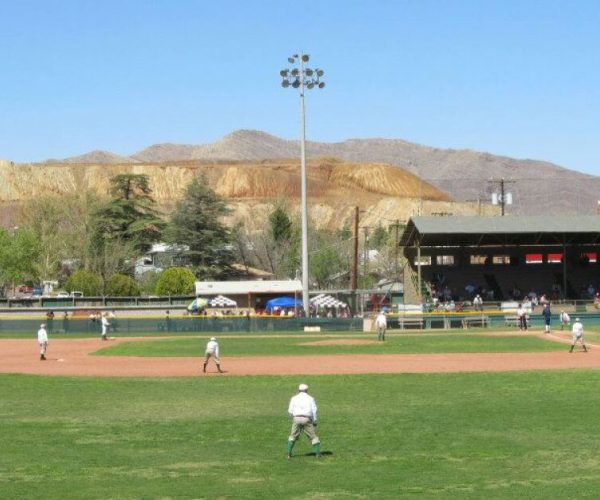
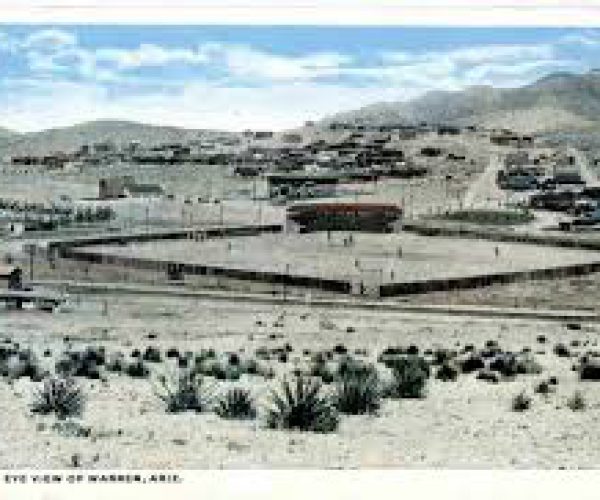
Arizona’s baseball roots run deeply through Warren Ballpark near Bisbee. It’s a little-known gem with a prestigious and varied history, where famous and infamous players alike played during a dicey era near the turn of the 20th century.

Built in 1909, Warren Ballpark is billed as the oldest multi-use stadium in the country. It pre-dates Boston’s famous Fenway Park, which opened in 1912.

While Warren Ballpark never hosted a World Series, it was the scene of one of Arizona’s oldest Major League quality matchups — a barnstorming exhibition game on Nov. 7, 1913, between John McGraw’s New York Giants and the Chicago White Sox, owned by legendary baseball magnate Charles Comisky.

Bisbee historian Mike Anderson notes that six Major League Hall of Fame players and managers participated in that game, including McGraw and Tris Speaker. Olympian Jim Thorpe, who also played for the Giants, hit a home run over the center field wall in that early Bisbee game.

But the ballpark’s rich and storied history goes far beyond the barnstorming teams. It was the home of an “Outlaw’’ team during the 1920s that included players banned by Commissioner Kennesaw “Mountain’’ Landis for betting on baseball during the Chicago “Black Sox’’ scandal in 1919. The Black Sox included Chick Gandal and Buck Weaver, who always denied wrongdoing.

Later, after Landis convinced the outlaw Copper League to fold, Warren Ballpark hosted minor league teams from 1928-1955, with players from the Bisbee Bees eventually reaching all 16 Major League teams at the time.

Warren Ballpark eventually was sold by the copper company that built it to the Bisbee school district, which still uses it for high school baseball and football games.

Hohokam Stadium

When fans pass through the turnstiles at Mesa’s Hohokam Stadium, they are honoring a Cactus League legacy that dates back more than 70 years, when rancher Dwight Patterson attracted the Chicago Cubs to rickety Rendezvous Park in 1952.

Rendezvous was demolished in 1976, but it was replaced a year later by Hohokam which rose a mile north of that original park.

The Athletics were the first tenant of Hohokam Stadium, but they literally swapped venues with the Cubs in 1979 – the Cubs returning to Mesa and the A’s moving to Scottsdale Stadium.

Hohokam was rebuilt in 1997 as a larger, more modern facility and it immediately paid dividends. The Cubs became a Cactus League favorite, setting attendance records at Hohokam in 2009 by drawing 203,105 fans.

That seemed to whet the appetite for a larger stadium. The Cubs played their last game at Hohokam in 2013 and moved into Sloan Park, only a few miles away in northwest Mesa, in 2014.

Baseball’s past, however, has a way of resurfacing in Mesa which put the highly functional Hohokam Stadium to good use. Seating was downsized to create a more intimate fan experience and the Athletics returned to Hohokam in 2015 and signed a 20-year lease.

Fun fact: Hohokam Stadium was the home field of the ASU Sun Devils in 2002, while the Devils’ traditional home, Packard Stadium, was being renovated.

Prescott Courthouse Plaza

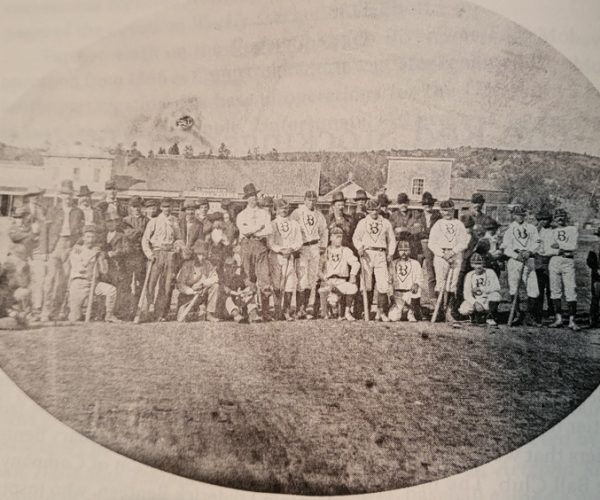
Prescott’s connection with baseball dates to at least 1866, according to newspaper archives.

The game came out west with Cavalry units. Baseball was encouraged as wholesome entertainment for soldiers to break up the boredom of frontier life. As nearby towns grew, the game spread and civilian teams formed.

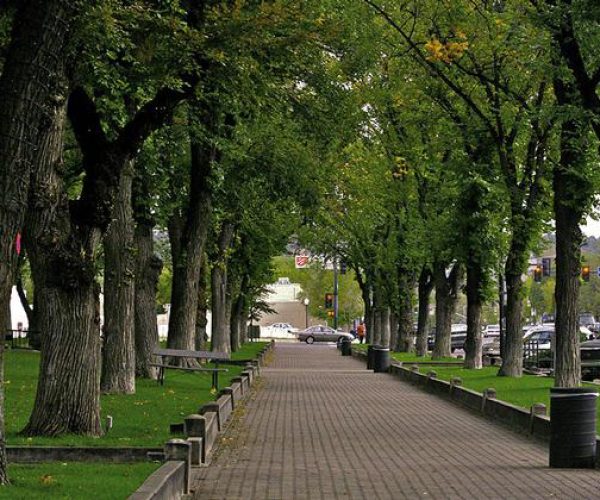
One of Prescott’s most notable games took place in May 1876 on the courthouse plaza — two years before Yavapai County built its first courthouse there and 40 years before the present courthouse opened in 1916.

Newspapers proclaimed the showdown between the Champions Baseball Club of Prescott and a team of U.S. Army soldiers from nearby Fort Whipple as Arizona’s first Territorial Championship.

Prescott beat Ft. Whipple 49-22 that day, “with help from the visiting members of the Boston Red Stockings team,’’ according to a display board that includes a picture at the Ft. Whipple Museum.

Although the participation of Boston players has been debunked by historians, that 1876 game helped establish what would grow to become a rich legacy of Prescott baseball.

Today that includes not only the courthouse plaza games, but the history at Roughrider Park at Yavapai College, home to three national collegiate championship teams and host to nearly two dozen players who have gone on to Major League Baseball careers.